
Wrangler vs. Bronco Off-Road: Buy for the Trails You Actually Drive
The badge doesn't pick the right rig. Your trails, your passengers and the drive home should decide where your money goes.
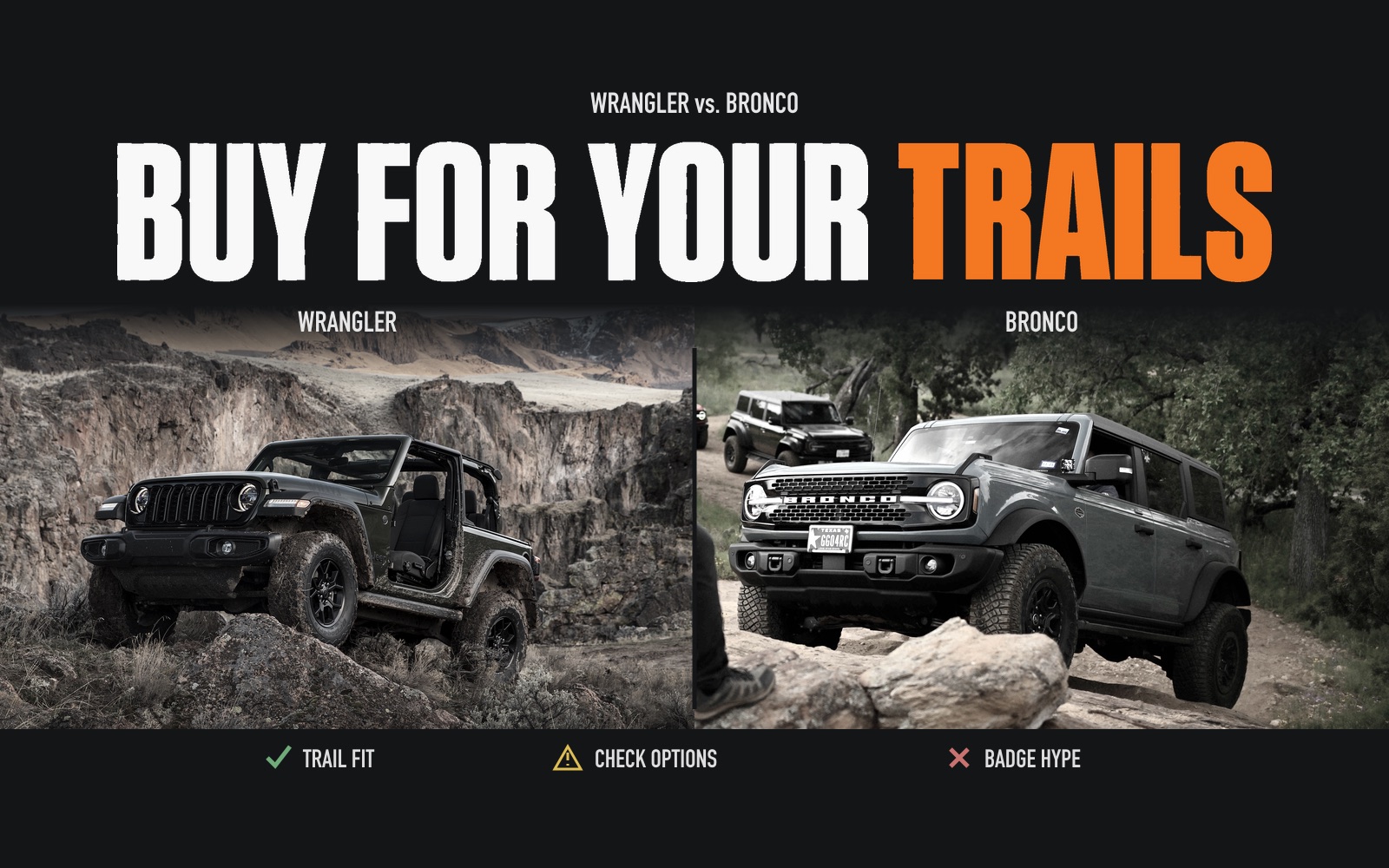
A rock garden doesn't care which grille won the comments section. Your commute doesn't care which rig looked tougher in a launch video.
The useful Wrangler vs. Bronco off-road answer starts with your actual routes. Our starting recommendation: put the Wrangler Rubicon first for a rock-focused build; start with the Bronco for mixed trail trips and substantial road mileage. For maintained access roads and camping, either may deliver everything you need without the biggest tire package.
That's a buying framework, not a claim that a Bronco cannot crawl or a Wrangler cannot commute. We're discussing U.S.-market, gas-powered vehicles, using current manufacturer equipment examples, and the full-size Bronco, not Bronco Sport.
Wrangler vs. Bronco Off-Road: Start With the Terrain
Write down the routes you genuinely expect to drive. Not the bucket-list obstacle you watched last night. The local park, forest access road or rocky climb you'll actually revisit.
Then describe what makes those routes difficult: ledges, slippery climbs, deep ruts, tight turns or distance from help. Those answers tell you more about useful equipment than an owner's club sticker.
| Your usual route | Start your shopping here | What to prioritize |
|---|---|---|
| Slow, technical rock trails | Wrangler Rubicon; compare equipped Badlands | Low gearing, lockers, articulation, protection |
| Rough access roads plus substantial pavement | Bronco; test-drive Wrangler too | Ride control, seats, tires, highway noise |
| Maintained forest roads and campsites | Less elaborate versions of either | Suitable tires, cargo fit, recovery planning |
| Tight, wooded trails | Compare short-wheelbase configurations | Actual width, turning room, passenger needs |
For Northeast drivers, the interesting question often isn't maximum desert speed. It's how comfortably the vehicle reaches the trail, how it fits between obstacles and whether you can place a tire accurately on wet rock.
Stay on permitted routes. A wider vehicle isn't permission to widen the trail.
Why the Rubicon Belongs on a Rock-Crawler Shortlist
The Wrangler retains solid front and rear axles. The Bronco combines independent front suspension with a solid rear axle, as Ford's technical specifications explain.
That architectural difference matters, but it doesn't settle every obstacle. A tire's ability to stay in useful contact with the ground also depends on suspension travel, setup and the driver's line.
The Jeep Wrangler Rubicon adds a particularly useful crawling toolkit. Jeep specifies a 4:1 low-range transfer-case ratio and an electronic front sway-bar disconnect. It also advertises an available 100:1 crawl ratio, but that requires the manual transmission and optional 4.88:1 axle gearing.
That last qualification matters. The headline number is not every Rubicon sitting on a dealer lot.
Low gearing helps you move deliberately; disconnecting the sway bar allows more front suspension articulation. Neither replaces traction, judgment or a spotter when you cannot see the tire placement.
Our preference for a rock-focused Wrangler build comes from that combination, not from pretending independent suspension makes the Ford helpless.
Check the Badlands Equipment, Not Just the Badge
The Ford Bronco Badlands offers front and rear electronic locking differentials. Lockers couple the wheels on an axle so a wheel with grip can keep contributing when its partner has little traction.
Here's the detail an older buying guide can miss: Ford's 2026 order guide makes the front stabilizer-bar disconnect optional on Badlands without Sasquatch. On Badlands with Sasquatch, it is included.
Read the window sticker. Do not assume the trim name guarantees the disconnect.
The Bronco Sasquatch package also changes the clearance conversation. Ford's specifications list 33-inch tires and 10.5 inches of ground clearance for a non-Sasquatch Badlands. The four-door Sasquatch configuration is listed with 35-inch tires and 11.5 inches.
Useful? Certainly, if clearance is what's stopping you. Automatically necessary for a camping access road? No.
Those are configuration-specific manufacturer figures, not proof that bigger tires fix line choice, traction or every obstacle.
The Drive Home Is Part of the Purchase
A Bronco deserves an early test drive when your weekends involve rough access roads and your weekdays involve pavement. But don't turn that recommendation into a promise that every Bronco rides softly.
Owner accounts disagree. In a Bronco suspension discussion, one member says their Wrangler on Rubicon suspension felt softer than their Badlands. Another prefers their Badlands and describes their household's Wrangler as much harsher.
Those are personal reports, not controlled testing or reliability data.
Drive the actual configurations you're considering on the same broken pavement and highway stretch. Compare steering corrections, seat comfort and roof noise with the tires at the specified road pressures. A modified used rig and a stock demonstrator aren't a clean suspension comparison.
This matters just as much to someone who enjoys street cars as someone planning a trail build. Wanting your daily driver to feel right isn't a failure of commitment to dirt.
Spend on the Problem You Actually Have
Before ordering a lift, establish what the stock vehicle cannot do on your intended route. Is it touching underneath, struggling for traction or simply being driven along the wrong line?
Those are different problems. They do not share a universal shopping cart.
For camping, load the gear you already own before buying storage systems. Check the specific vehicle's payload label and account for occupants, accessories and luggage together. A catalog photo doesn't carry your equipment.
For used examples, prioritize service records and an independent inspection of steering, suspension, underbody damage and modification quality. Neither a Jeep badge nor a Ford badge proves the previous owner maintained it properly.
Price the complete ownership plan: tires, insurance, maintenance, training and trips. A less elaborate rig you can afford to use beats a spectacular build that never leaves the driveway.
Quick Answers
Is a Wrangler better than a Bronco off-road?
Not on every route. We would start with a Rubicon for a rock-focused build and a Bronco for mixed trail and road use, then compare actual equipment and condition.
Does every Bronco Badlands have a sway-bar disconnect?
No. For 2026, it is optional on Badlands without Sasquatch and included on Badlands with Sasquatch; verify the specific vehicle.
Do I need Sasquatch for forest roads?
Not automatically. Its larger tires and additional clearance matter when the route demands them, not simply because the pavement ends.
Which is more comfortable as a daily driver?
Start by test-driving the Bronco, but don't skip the Wrangler. Owner reports differ, and tires, suspension configuration, roof and personal preference all affect the result.
Our Take
Buy for the difficult section you encounter regularly, not the most dramatic clip in your feed.
A Wrangler Rubicon makes sense when deliberate crawling is the point. A properly configured Bronco makes sense when the trip mixes road miles and varied terrain. Neither needs to become an expensive imitation of somebody else's build.
Which trail would you drive next weekend, and what specific obstacle would make you choose a Wrangler over a Bronco, or the other way around?