
40-Inch Tires on a Wrangler: Price the Whole Build First
Going from 37s to 40s starts with tires, but the budget can reach much further. Here’s how to assess the whole Wrangler before committing to bigger rubber.
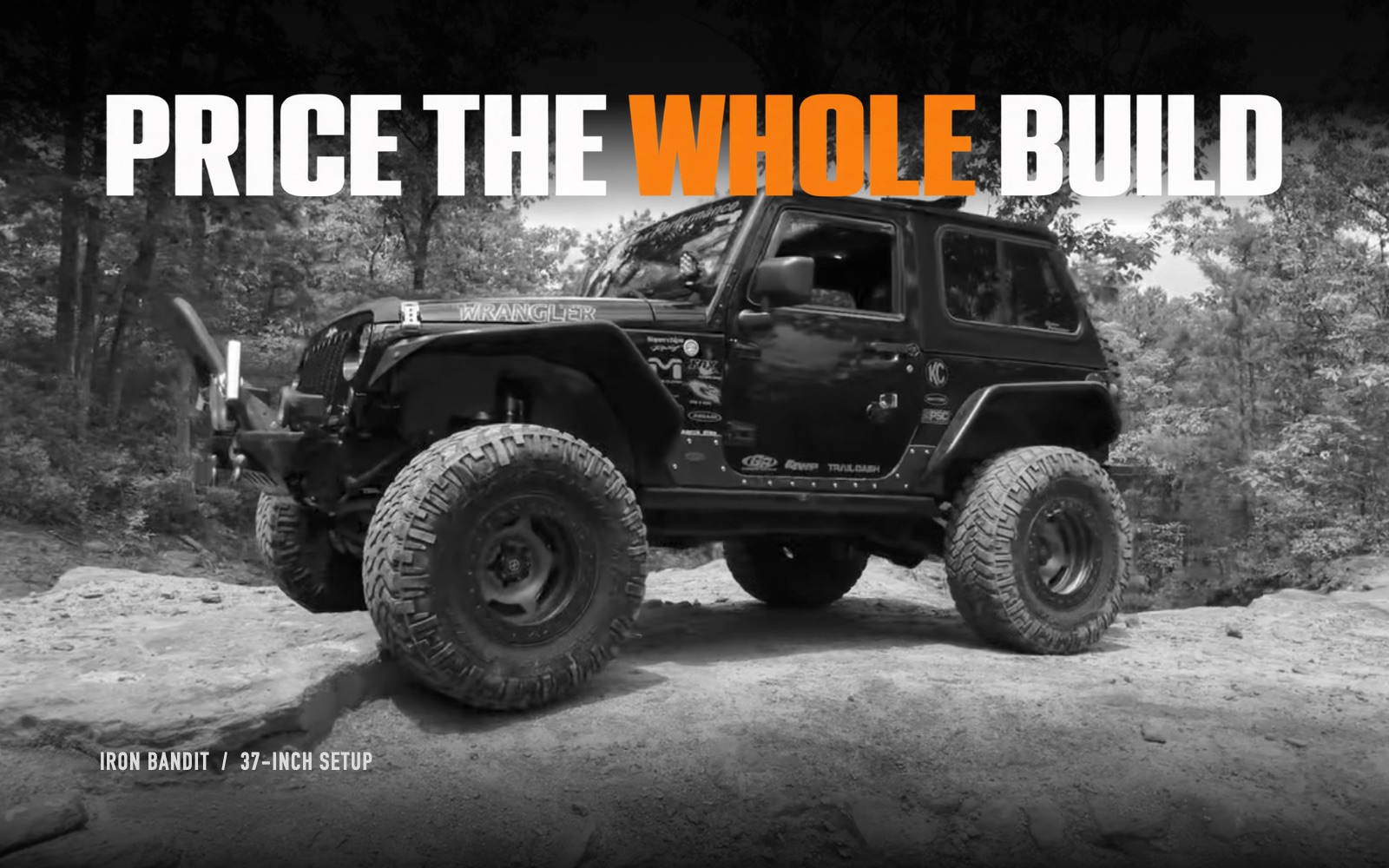
The tire cart is the easy part. It doesn’t ask what axles you have, whether the spare fits, or how the Jeep gets home.
If you’re considering 40-inch tires on a Jeep Wrangler, price a complete, vehicle-specific build before ordering rubber. That means assessing clearance, axles, gearing, steering, brakes and the spare—not assuming every Jeep needs replacement axles, or assuming yours needs nothing else.
Our position: buy the capability you will use, with a plan you can afford to finish.
40-Inch Tires on a Jeep Wrangler Start With the Jeep
Start with the actual vehicle: model year, trim, engine, axle assemblies, existing modifications and loaded weight. Then describe the trails you drive and whether the Wrangler also handles the commute.
“Wrangler on 40s” leaves out most of the information that determines the build.
The current JL Wrangler Forums discussion, “I’m going 40s—made up my mind,” captures the argument: targeted upgrades and careful driving versus budgeting for heavier-duty running gear. It’s a community-specific discussion, not evidence that everyone is suddenly buying bigger tires.
The disagreement also appears in an earlier owner cost discussion. Some members report factory-axle setups working for their use; others describe breakage and extensive replacements. Those are useful experiences. They aren’t controlled tests or a failure-rate database.
Ask what those Jeeps actually do before copying their parts lists.
37 vs 40 Inch Tires: Measure the Gain
Here’s a concrete example. Mickey Thompson’s Baja Boss M/T specifications list the 37x12.50R17LT at 36.8 inches in diameter and approximately 79 pounds. The 40x13.50R17LT is 39.8 inches and approximately 92 pounds.
Calculated from those figures, the larger tire adds 13 pounds per corner: 52 pounds across the mounted set, or 65 pounds including a matching spare, before changing wheels. The spare is carried weight, not rotating weight.
The diameter difference produces a theoretical 1.5-inch increase in clearance beneath the same axle—not three inches. Loaded tire deflection and pressure affect the real result.
Those figures describe these specific sizes and this tire model. They don’t establish a universal weight penalty or clearance gain for everything labeled 37 or 40.
That extra clearance can matter on the rocks you repeatedly catch. The useful question is whether it solves your recurring problem, and what you’re willing to change to get it.
Dana 44 on 40s: Experience Needs Context
The strongest argument for retaining factory axles is straightforward: owners have done it, and replacing functioning assemblies may be unnecessary spending for a particular vehicle and use.
The strongest argument for heavier-duty axles is equally reasonable: some owners want more durability margin before committing to demanding trails, rather than making a repair decision after something breaks.
Neither side gets to turn its experience into everybody’s guarantee.
“Mine survived” doesn’t establish the remaining margin in your Jeep. “Mine broke” doesn’t establish that every similar-looking Jeep will fail the same way. We have no verified universal Dana 44 tire-size limit or failure probability to offer here.
For Jeep Wrangler axle upgrades, get a recommendation tied to your exact assemblies, vehicle weight and intended use. Ask the builder to explain which components they would retain, which they would replace, and why. A slogan about doing it right is a poor substitute for that explanation.
Get a Quote That Includes the Supporting Work
Request an itemized assessment before deciding which parts are mandatory. This is a quote framework, not a universal shopping list.
| Build area | What to assess and price | What the quote should clarify |
|---|---|---|
| Tires and wheels | Exact sizes, wheel compatibility, mounting and balancing | Complete installed package |
| Axles and gearing | Retained assemblies, upgrades or replacement, setup labor | Parts staying and parts changing |
| Suspension and clearance | Steering lock, suspension travel, bump stops and body clearance | Fit throughout usable movement |
| Steering and brakes | Existing condition, compatibility and required changes | Suitability for the finished vehicle |
| Spare and carrier | Matching spare, mounting system and access | Where it fits and how it is supported |
| Installation and setup | Labor, alignment, calibration, fluids and follow-up | Included work and exclusions |
Have the shop distinguish existing maintenance needs from changes caused by the bigger tires. Otherwise, worn-out parts can make the tire decision look more expensive than it is—or disappear from the quote until installation begins.
Ask for the installed total, including tax and any outside work. If something remains provisional, get the assumption written down.
We’re deliberately not attaching a universal dollar figure. A tire-only purchase and a complete axle conversion are different jobs, and a forum member’s invoice isn’t a current quote for your Wrangler.
An Axle Swap Can Change the Wheel Plan
Consider Dana’s Ultimate Dana 60 package for the Wrangler JL. Dana lists 35-spline chromoly shafts, 3.5-inch axle tubes, an eight-lug 6.5-inch bolt pattern and upgraded brakes.
That illustrates why the axle decision belongs ahead of the wheel order. Compatibility reaches beyond the differential.
It does not prove every Wrangler on 40s needs that package. It does make “I’ll sort the axles later” worth questioning if the wheels you buy now won’t suit the eventual build.
Also be honest about the drive home. A Northeast trail Jeep may spend its weekend among rocks and tight trees, then carry people and gear along wet roads. Put that entire trip in the brief you give the shop.
Quick Answers
Can you run 40-inch tires on stock Wrangler axles?
Some owners report doing so, but their results don’t establish suitability for every Wrangler. The specific axle assemblies, vehicle weight and intended use need assessment.
How much clearance do 40s add over 37s?
In the Baja Boss M/T example above, the listed diameters imply 1.5 inches of additional clearance beneath an unchanged axle before loaded deflection. Actual tires and operating conditions matter.
Do 40-inch tires require Dana 60 axles?
The evidence here does not establish that as a universal requirement. Replacement axles are a build decision that needs a vehicle-specific explanation.
How much does converting a Wrangler to 40s cost?
There is no verified universal installed total. Get an itemized quote covering the tire package and the supporting work your Jeep actually requires.
Our Take
We’re not going to pretend 40s aren’t appealing. If they solve a real trail limitation and the complete build fits your budget, make the plan and enjoy it.
But keeping a sorted Jeep on 37s can be a deliberate choice. So can building around 40s from the start. The mistake is buying the tires before understanding which project you’ve signed up for.
For the trails you actually drive, would you keep 37s, run 40s with targeted upgrades, or budget for heavier-duty axles—and what experience made that decision for you?