
2026 Subaru WRX Base: A Bargain You Can Live With?
The base WRX keeps the manual, AWD and full engine output. Whether it belongs in your driveway comes down to the compromises you’ll live with every day.
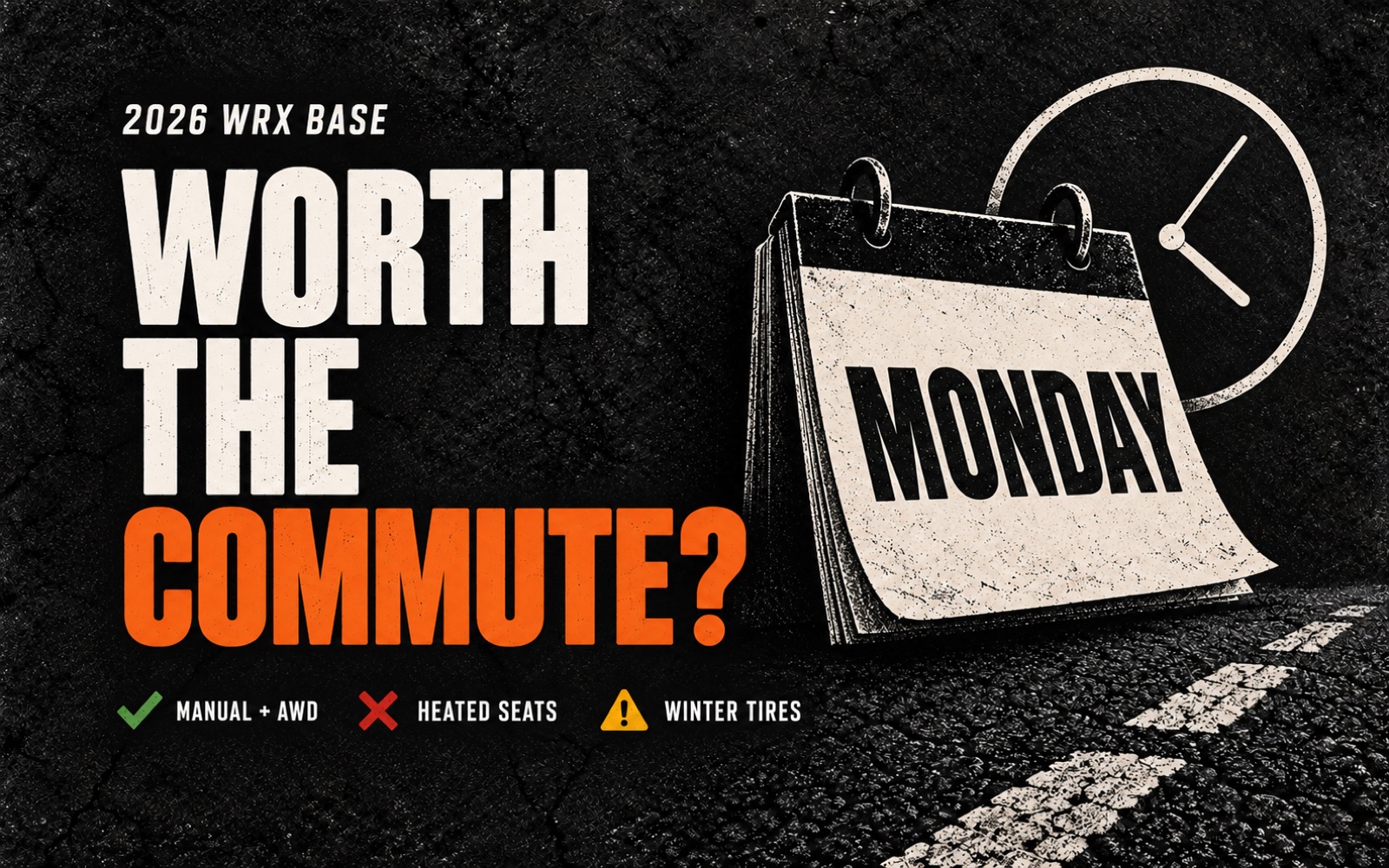
A bargain has to survive the drive to work.
The 2026 Subaru WRX Base makes a strong case for itself: manual transmission, all-wheel drive and the same engine output as the expensive versions. Our answer is yes—it deserves a place on your shopping list if those are the things you want. But the Premium’s useful comforts, the cabin experience and your winter-tire budget deserve as much attention as the starting price.
The renewed discussion around Car and Driver’s October 5 test update makes this a good time to ask what value actually means. We’re assessing confirmed specifications and published road tests here; the ownership verdict is our editorial judgment.
Why the 2026 Subaru WRX Base deserves a look
Subaru hasn’t made the affordable version interesting by deleting the interesting parts. Its official features guide lists a turbocharged 2.4-liter flat-four producing 271 horsepower and 258 pound-feet of torque, with standard AWD. The Base pairs that hardware with a six-speed manual.
That combination is the reason to consider it. You get to choose the gear, work the clutch and participate in an ordinary drive without buying an expensive trim to unlock the engine.
You also have to want that participation on an ordinary drive.
In the community discussion that prompted this story, enthusiasm for the package sits beside complaints about clutch and shifter feel, cabin compromises and the sedan body. Those are individual preferences, not evidence that everyone will love or hate it. They’re also more useful shopping questions than whether strangers approve of the cladding.
Base versus Premium: spend for something you’ll use
Subaru’s U.S. price sheet puts Base MSRP at $32,495. Add the standard $1,195 destination charge and it becomes $33,690, before taxes, registration, dealer fees or options. Destination varies in some states, including several in the Northeast, so check the actual sticker.
These are published starting figures, not promises about a dealer’s offer. Equipment differences below come from Subaru’s model announcement.
| Trim | Starting MSRP | Relevant equipment |
|---|---|---|
| Base | $32,495 | Manual, AWD, summer tires |
| Premium | $33,995 | Heated front seats and mirrors; wiper deicer |
| Limited | $38,995 | Power driver’s seat; blind-spot detection; moonroof |
The Base-to-Premium difference is $1,500. In a cold climate, heated seats, heated mirrors and a wiper deicer are a credible reason to spend it. There’s no enthusiast medal for deliberately being uncomfortable.
Equally, skip equipment you won’t miss. The right trim is the one whose extras earn their place in your routine. Compare similarly equipped written quotes before deciding; a discount or unwanted accessory package can change the apparent gap.
The commute exposes what the spec sheet misses
A manual AWD sedan can be good company without being a polished commuter. That’s the compromise to investigate.
Edmunds’ firsthand test found supportive seats and suspension that remained tolerable over broken highway pavement. It also criticized the cabin materials and slow touchscreen responses. Its testers described relatively light steering and longish shifter throws, with positive gear engagement.
Those observations give you a test-drive agenda, not a substitute for driving it yourself.
Pair your phone before leaving. Adjust the temperature, find your usual audio controls and see how the screen behaves in sunlight. Spend time at steady road speed with the stereo off. Ask a regular passenger to come along.
Car and Driver recorded 74 decibels at a steady 70 mph. That is a measurement from its test, not a prediction for every pavement or tire condition. It is a useful reminder to judge cruising noise separately from how entertaining the engine sounds.
A hood scoop doesn’t make an irritating commute less irritating.
AWD still needs a winter plan
Subaru supplies the Base with summer performance tires, as confirmed in its model announcement. If this is your year-round car in Pennsylvania or New England, include suitable winter tires and seasonal fitting or storage in the ownership budget.
Michelin’s tire guidance explains that summer tires aren’t intended for snow and ice, and that AWD doesn’t remove the need for appropriate winter tires. The drivetrain badge cannot fix an unsuitable tire compound.
Fuel deserves the same honesty. Edmunds lists EPA estimates of 19 mpg city, 26 highway and 22 combined for the manual Base. These are ratings, not a guarantee for your commute.
Get an insurance quote for the actual car, too. We aren’t assigning a universal ownership cost: mileage, location, coverage and tire choices make that misleading. The useful number is what this WRX would cost you to keep, alongside the car you’re replacing.
Test the life you have
Ask for a route that includes your normal kind of traffic and imperfect pavement. Pay attention to smooth starts, parking maneuvers and how easily you settle into the driving position. A car that feels exciting during a brief demonstration still has to work when you’re tired.
Bring the awkward thing you regularly carry, whether that’s a child seat, work bag or sports equipment. Don’t let a salesperson’s reassurance replace checking the fit.
Then leave the modification shopping cart closed for a while.
If you already expect to replace the suspension, seats or exhaust to tolerate the car, reconsider whether its starting price tells the whole story. If you enjoy it as delivered, the Base’s simplicity starts looking much more convincing. Buying less equipment can be satisfying without becoming a project.
Quick Answers
How much does the 2026 Subaru WRX Base cost?
Published U.S. MSRP is $32,495, or $33,690 with the standard destination charge. Taxes, other fees, options and regional destination differences can change the total.
Does the Base have less power than higher trims?
No. It retains the same engine output; its lower price mainly changes equipment rather than the core powertrain.
Is the WRX Premium worth the extra money?
The published MSRP gap is $1,500. Its heated seats, heated mirrors and wiper deicer make it worth comparing for a cold-weather daily driver.
Can the Base’s standard tires handle a snowy winter?
The standard tires are summer performance tires. Plan for suitable winter tires if snow, ice and freezing conditions are part of your driving.
Our Take
The Base WRX is compelling because you can buy the core driving experience without climbing the trim ladder. That’s a welcome option for someone who wants an interesting everyday car.
Our preference would be to start there, compare the Premium’s useful equipment, and let a representative test drive decide. Keep money available for the tires and ownership costs that make the car work in your life.
Buy it because you like living with it. The bargain argument should support that decision.
For your daily drive, would you keep the Base and the savings, pay for the Premium’s heated comforts, or choose a different car—and what would decide it?